
Saturday 2nd August 1975
The Cabinet of Dr Caligari (1920,Decla-Bioscop AG , Robert Wiene) 22.55-00.05
Quatermass 2 (1957, Hammer, Val Guest) 00.05-01.20
I’d like to share a moment with you, if I may.
A couple of nights ago, I took my dog out into the garden. Nothing remarkable in that, admittedly – a last late-night pee for the hound gives me a better chance of not being woken at five in the morning by a yowling cross-legged canine, so it’s part of a regular routine. What was less regular, however, as I stood looking at the stars and waiting for the doggy leg-lift to signal bedtime, was that quite suddenly a pair of bats scuttered overhead, circling above me maybe four or five times before disappearing. That’s unusual here. I’m not sure why, there’s plenty of trees and old buildings around which might make it seem like suitable territory, but still a bat-sighting is much rarer around my house now than it was anywhere I’ve previously lived. As such, I was startled and consequently completely unprepared for the quite extraordinary Proustian rush the moment bestowed upon me. In that moment, quite suddenly, I was twelve again. Not remembering, not recalling, but actually twelve, deep down inside myself, just for an instant. For reasons that don’t need going into here it’s been a difficult few days personally, but all that was simply gone – all the anxieties and complexities that adulthood and parenthood and late middle age inevitably brings were gone, and just briefly I was once more a wide-eyed adolescent on the edge of something magical.
You see, back garden bats flitting and skittering against a nightblue sky on a long summer evening was always one of the markers of the Saturday night excitement, the sheer ‘can’t waitness’ with which I used to anticipate each BBC2 Saturday night horror double bill back in the late 70s and early 80s. And those were the moments I was suddenly and magically experiencing once more, for just the briefest of spells. For that, I’d like to thank my unexpected bat-guests. But I’d like to thank the horror double bills themselves even more. It’s remarkable to me that the impact those strange and wonderful old films had on me all those years ago was so profound, and is so deeply embedded in me, that even that briefest of glimpses of the way they made me feel was enough, however briefly, to simply erase whatever worries and difficulties were preoccupying me in the here and now.
And this is a good and special moment to pay that kind of tribute to the horror double bills, because they are fifty years old today. I usually try not to be too topical in anything I post on here, since it may end up having little or no relevance if someone reads it at a later date, but in this instance I’ll say it loud and proud. This is Saturday the second of August 2025, and exactly fifty years ago to the day, Saturday the second of August 1975 marked the very first pairing in the legendary BBC2 summer seasons of horror double bills.
I must confess that, like an unreconstructed 1950s husband, I wasn’t present at the birth. I only came to the double bills a couple of years later, in 1977 – there’s an excellent book about it which I heartily recommend – and, when my slightly older and equally horror-obsessed cousin mentioned to me at some point a year or so later that there had been a couple of seasons before 77 I found it difficult to believe at the time since that season – given the umbrella title ‘Dracula, Frankenstein and Friends’ – had seemed such a perfect introduction to the genre. Nonetheless it was true, and I must say that the double bill pairing which kicked it all off in 1975 wasn’t a bad place to start.

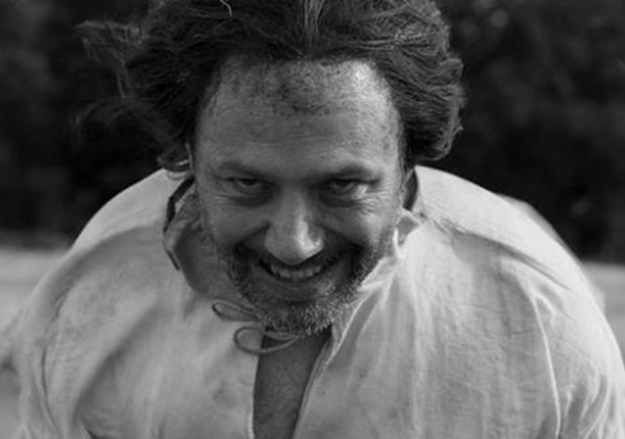
Many would argue that The Cabinet of Dr Caligari could be seen as the very first horror film. It was certainly extraordinarily influential; the film that launched German Expressionism in the cinema, a movement that was responsible for much of the visual style characteristic of the classic Universal horror films of the 30s and 40s. Even so, I’ll stand by my opinion, expressed in print in the aforementioned excellent book, that the expressionist masterpieces of the 20s are arthouse experiments rather than genre films, and that consequently the 1931 Lugosi Dracula (with which the 1977 season began) is the first true horror movie. That’s not to undervalue Caligari however. Even today, at a century’s distance, it’s an extraordinary and unsettling watch. The artistic courage to dispense altogether with any pretence at naturalism is astounding. Of course George Méliès’ magic box of tricks preceded Caligari, but his films, visionary as they were, utilised trick photography and fantasy elements to supplement an essentially real world. Caligari, on the other hand, replaces the external world entirely by putting inner psychological turmoil on screen, in the mise en scene, in those extraordinary angular sets, in the painted shadows, in the on-screen text (ninety years before Sherlock!) which persecutes Caligari as he walks, in the stylised performances. The result – appropriately enough – is mesmerising. Much of the visual iconography – the black-clad ‘monster’, the white-clad swooning heroine, the pursuit over the rooftops, even the mad scientist trappings of Caligari himself – continues to echo down the years and through the history of the horror film. For me, at least, the most powerful moment of all – the close up in which Conrad Veidt’s somnambulist Cesare slowly opens his heavy eyes to reveal a gaze that seems to be staring out from another dimension – sees its fullest inheritance in Karloff as The Monster, or as Im-Ho-Tep, but even finds a distant echo in Reece Shearsmith’s strange, glassy and quite terrifying grin as he emerges from a tent which contains Hell in Ben Wheatley’s 2013 A Field in England.
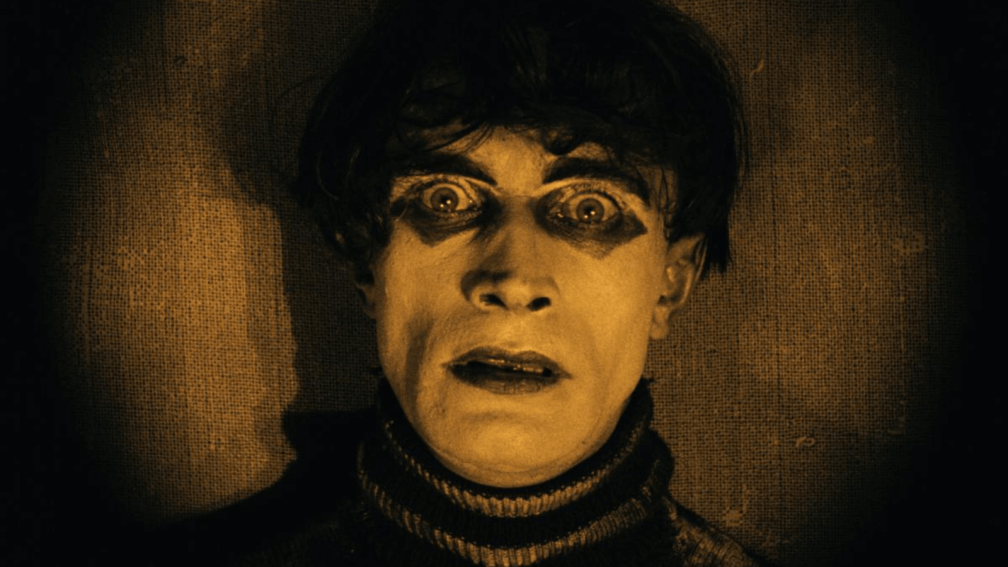
It can often be seen as a sign that a film is Important with a capital ‘I’ when so many people involved are eager to claim it as theirs. Look at the authorship debates surrounding Citizen Kane for instance. If so Caligari is A Very Important Film Indeed. The writers, Carl Mayer and Hans Janowitz, maintained that all of the film’s innovations – set design included – were the result of their script. They also claimed that the film’s framing device (that the story is a tale told by a madman in an asylum) was the disastrous intervention of the director Robert Wiene, who otherwise contributed little, and had the effect of neutering their intended political message about a generation sleepwalking into war under the control of sinister higher powers. Their claims are repeated pretty much verbatim in Siegfried Kracauer’s very influential critical work From Caligari to Hitler and for many readers as a result became almost the ‘official’ version. Wiene, however, deserves greater recognition. If nothing in his later career quite reached the heights of Caligari – and the same could certainly be said for the scriptwriters – Raskolnikow, his 1923 adaptation of Dostoevsky’s Crime and Punishment, and 1924’s The Hands of Orlac show that he could find his own way around expressionist design and filmmaking very effectively. One might easily argue, in fact, that the decisive contribution to Caligari came neither from Wiene nor Mayer and Janowitz but from the production designer Hermann Warm. Of course, no matter what the 1950s Cahiers Du Cinema critics might say, no film, however idiosyncratic, ever truly has a single auteur. By its very nature film, like theatre, is a collaborative medium, and the power of Caligari comes from the contributions of all its creators – as well as the remarkable performances of Conrad Veidt (better known to later audiences as Casablanca’s evil Nazi) and Werner Krauss. And all together, the creators of Caligari produced a remarkable, and remarkably influential masterpiece which, if it’s not quite the first horror film, is certainly its spooky godfather and a more than appropriate choice to launch the BBC2 horror double bills.
So too was its second of August bedfellow, even if beginning a film series with a sequel might seem a somewhat odd call. Still, after Caligari, there can have been few works more influential and through-the-years important than Nigel Kneale’s Quatermass stories, and if the first in the series of Hammer’s big-screen adaptations The Quatermass Xperiment might have been a more chronologically logical starting point, and if, at least for me, their third, Quatermass and the Pit, would have been a more atmospheric and profoundly unsettling one, no less a student of Hammer Films than David Pirie names Quatermass 2 as the best of the bunch, and who am I to argue?
It’s certainly true to say that there hasn’t been a paranoid sci-fi/horror hybrid since Quatermass 2 which doesn’t owe it something – with the possible exception of Invasion of the Body Snatchers, and that only because the two films were made almost contemporaneously. Whether it be the alien-possessed human beings, the sense of government and government agencies themselves being infiltrated and controlled, the idea of vast conspiracy, wheels within wheels and secret government institutions, the sense of drift towards totalitarian control – some of the plot elements and imagery in Kneale’s script were themselves partly inspired by his own recent experience adapting Orwell’s Nineteen Eighty Four for a controversial 1954 television play. Even the changing post-war British landscape – huge industrial complexes and new towns – is grist for Kneale’s hugely influential paranoid mill. And unlike the preceding Quatermass Xperiment – for which he began a lifetime tradition of hating productions of his own work – Kneale had the opportunity to write the screenplay for Hammer’s Quatermass 2 himself and was able, to some extent, to soften the rougher edges of American actor Brian Donlevy’s bulldozing Quatermass which he had found so unwelcome in the first film.
The result is urgent, frightening and powerfully effective, a semi-apocalyptic vision of Britain and the world which Kneale would push to even further near-future extremes in the final instalment of his Quatermass saga, the simply titled Quatermass, made for ITV in 1979 with John Mills. And in the moment a man stumbles down an iron stairway covered from head to foot in a kind of glutinous, burning alien black oil, Quatermass 2 offered – even if it was unbeknownst to me at the time it screened on Saturday 2nd August 1975 – the first in a long series of memorably striking and horrific single images which were to form a central and pivotal thread in my lifelong relationship with the double bills, and with the horror genre more generally. A gravedigger’s spade piercing a coffin in Kiss of the Vampire, John Laurie’s Mad Peter foaming at the mouth in The Reptile, the crash zoom into Christopher Lee’s disfigured face in Curse of Frankenstein, or to the ‘poor wretch’ buried alive in Premature Burial, and on, and on.

Those moments, and so many, many others from so many, many films remain burned into me, wonderfully and indelibly, and it was such moments, and all the things they have meant to me for the past fifty years, that I found myself so suddenly and surprisingly flashing back to just the other night as two bats wheeled and flickered around my head. And just as the double bills themselves had offered me comfort, and reassurance, and joy, and escape in those long gone and far away 1970s nights, I found to my delight they still retained – albeit briefly – the power to transcend and supersede the fears and stresses and failures with which every life, mine certainly included, must contend, in much the same way as they have been helping me to do for almost fifty years.
So, horror double bills, a very happy fiftieth birthday to you. My best wishes, and thanks, always.
 Dracula, Frankenstein and Friends