

Even before the new era proper begins next month with what is -again – being called Series One, there have already been many welcome features of the ‘Russell T Davies: The Return’ era of Doctor Who; or ‘RTD2′ as those cheeky online scamps dubbed it almost as soon as his announcement as the returning showrunner was made public. The chance to spend a little more time in the company of David Tennant and Catherine Tate and, most movingly of all for me, a final glorious couple of moments with Bernard Cribbins’ majestic Wilfred Mott. The joy of The Giggle. What looks to be an inspired piece of casting in Ncuti Gatwa. An unlikely assault on the charts with a catchy number about goblins eating babies. The ‘tear to the eye’ online Tales of the Tardis mini-episodes revisiting old companions and Doctors. A fascinating editing and colourisation job done on the original Daleks serial. In fact there’s been so much good stuff that I’m prepared to draw a discreet veil over the rather ghastly, clunkingly awkward virtue-signalling climax to The Star Beast (What are the alien’s preferred pronouns? Non-binary trans joy saves the universe?? A male-presenting Time Lord just wouldn’t understand??? Oh Russell, please. You’re a much better writer than that…) and say no more about it.
Best of all for me, however, has been the appearance of ‘The Whoniverse’ on the BBC iplayer. The chance to have the entire still-existing back catalogue of the show available to stream for free in a single place – or almost all of it since a mean-spirited public tantrum thrown by the son of the writer Anthony Coburn has denied us the very first story – is a truly wonderful thing. A proper piece of Public Service Broadcasting in the digital age, and yet one more reason – alongside the very existence of New Who at all – why I for one will be eternally grateful to Russell T, since by all accounts it was his dogged insistence that saw all the rights issues finally resolved.
Not that I needed The Whoniverse of course. I’m of that paranoid generation who clings desperately to physical media, because my DVDs and blurays will not suddenly disappear from my shelves – barring a villainous act of Whovian burglary – unlike the availability of many a favourite series from streaming platforms at the whim of some anonymous and faceless executive. So all of Who was already available to me, of course, on DVD or, as time passes, through the ongoing releases of the rather wonderful Doctor Who – The Collection season boxsets. But something in the ease of it, all of Who assembled online as a single entity, moving through the entire thing from one episode to the next with a single click on the remote, lends itself beautifully to the binge watching sensibility in a way that physical media never quite does. So although I never needed The Whoniverse, I found myself somewhat surprised by how much I had wanted it without realising it.
But then of course, the vastness of this sixty year treasure trove begs the question ‘Where do I start?’
To begin at the beginning, as Dylan Thomas might have it, with a total rewatch? Coburn Junior’s strop means no Unearthly Child but more than that, it didn’t feel right to me. For one thing, in beginning with the Hartnell and Troughton years there’s the issue of the Missing Presumed Wiped episodes to contend with. Many of these are now available as animations, but not all of them, and grateful though I am for the animated versions they’re still not exactly the real thing which makes the experience always feel a little incomplete to me. Besides which, as anyone who has read my book Dracula, Frankenstein and Friends will know, my egomania runs so rampant that, with Doctor Who just as with old horror movies, I’m always liable to be more interested in my personal history with the series than in the history of the series itself.
And so for me, faced with the vast sweep and majesty of The Whoniverse, there was only one place I was going to begin. The place it began for me as a five-year-old boy. With Jon Pertwee’s arrival as the Third Doctor. Of course, any simple, dramatic statement like that is, in one sense, a lie. Memory and experience are not simple. In fact, my first memories of Who are a little earlier, from Patrick Troughton’s time as the Doctor. But those memories are broken, vague and fragmented, and they are all to do with terror and monsters and the cliché of watching from behind the sofa. The hissing voices of the Ice Warriors frightened me beyond measure, fuelling my pre school nightmares, and alongside that I seem to recall a series of horrifying black and white visions of the Earth drowning in foam which made me suspicious of our twin-tub top-loading washing machine for months. But that’s about it. I have no recollection of Troughton’s Doctor at all, nor of Jamie or Victoria or Zoe, nor of the way any of the stories unfolded. So at first there was only fear.
And then there was Pertwee. And for the first time, at five, I began really watching the show rather than hiding from it, and if at first there was only fear then Jon Pertwee was the perfect hero to guide me through it. Effortlessly commanding, charming, and reassuring, it was Pertwee who taught me not to be afraid. So long as the Third Doctor was around, warbling a Venusian lullaby while reversing the polarity of the neutron flow, rubbing the back of his neck ruefully when things got complicated before hurtling towards the source of the trouble in his yellow Edwardian roadster Bessie or spinning a stuntman off his feet with a resounding ‘Hai!’ I knew that everything was going to be alright.
When people learn that you’re a Who fan, they will almost inevitably ask at some point ‘Who’s your Doctor?’ as though you were only allowed one. My answer is always more complicated. You see I’ve loved them all, in different ways and for different reasons. Tom Baker, Pertwee’s successor, is always going to hold a very special place in my heart, because he was the Doctor I grew up with, the Doctor of my adolescence, a wild, anarchic, unpredictable, impish figure perfectly suited to me in those years. When he left the show I drifted away, but that meant that I had the pleasure of later discovery and delight in the performances of Peter Davison, Colin Baker and Sylvester McCoy through UK Gold marathon repeats in the 90s, just as the pleasures of DVD reinforced my Target-novelisation-inspired love of Hartnell and Troughton. And every actor who has played the role since has been wonderful. Paul McGann is an absolute joy in the TV movie and I truly wish we’d had the chance to see much more of him. Eccleston broke down so many wrongly negative perceptions with his grounded, gritty, nuanced performance (remember some of the names the press were suggesting before his casting? Paul Daniels anyone?). Tennant soared through a wonderful era of storytelling, and Matt Smith and Peter Capaldi both shone as Steven Moffatt took the show into darker, more complex territory. Jodie Whitaker was joyous, even when some of the stories she was given were not so strong, and when they were worthy of her – The Flux, The Power of the Doctor – she was magnificent. But if I’m to be allowed only one, it might well be Pertwee, because he is lodged most closely of all to my childhood heart. If Tom Baker, a wilder, more unpredictable, even dangerous presence was the Doctor for my adolescence, Pertwee – heroic, powerful and reassuring – was my childhood Doctor.

Firstly, at least for me, its extraordinary just how well the Pertwee era holds up, even fifty years on. Of course there are one or two dodgy special effects – yes, I’m looking at you Invasion of the Dinosaurs – and of course the pace of the editing would feel a little slow to a modern generation. But the pace of the storytelling remains thrillingly effective. In fact, by comparison with some of today’s more bloated streaming service adaptations and original series, the narratives feel almost turbo-charged. The stories, in the main, remain almost every bit as gripping and enthralling as I found them back in the early 70s. Most of the credit for that, of course, must go to the great Terrance Dicks, who served as script editor throughout the Pertwee years, and whose exceptional degree of interest in and understanding of stories, of what makes stories work and what stops them from doing so, of the narrative engine that makes them tick, served the period so incredibly well. If Robert Holmes, Dicks’ successor as story editor, is the great ideas man of classic Doctor Who – all atmosphere and world-building and vivid characterisation – then Terrance Dicks is its master of structure and pacing and the ways in which a plot coheres. I once saw Billy Wilder being interviewed about his film version of Agatha Christie’s Witness For The Prosecution and he made this fascinating distinction between two different types of writer, using Christie herself and Raymond Chandler as examples:
Take two writers: Raymond Chandler and Agatha Christie. If only Chandler had a feeling for construction! Chandler would be unbeatable if he knew how to construct! Great style, very descriptive, but hard to dramatise. Christie constructs like an angel, with surprises. But her language is flat – no dialogue, no real people. Twist after twist after twist. It’s very good plotting. For every five hundred great dialogue writers, there are five great constructionists. That’s the toughest job in the world.
Although Terrance Dicks was more than capable of a well-turned phrase (‘Through the ruin of a city stalked the ruin of a man’ anyone?) or a line of memorable dialogue, and Robert Holmes knew exactly how to put a story together, if we boil Wilder’s point down to its essentials then Holmes is Who’s Chandler and Dicks is its Christie. And under the watchful eye of the master constructionist, the Pertwee years offer up a string of wonderful stories in quick succession. There’s barely a truly duff note in the whole five years.
Almost as much credit for this, of course, should go to Barry Letts as producer. Both he and Dicks, who remained great friends throughout their lives, were always at pains to emphasise just how collaborative their approach always was, so much so that it was almost impossible to say exactly who had come up with which ideas. If it’s fair to say though that Dicks was the master of the nuts and bolts of the script, it might be fair to also suggest that Letts was responsible for a lot of the overarching vision of the era, and in particular the moral compass which the Pertwee years adopted. A number of Pertwee’s stories are infused with Letts’ Buddhist outlook, and a number of them also reflect powerfully on the issues of the day, providing the show with a more specific social conscience – beyond the straightforward morality of good against evil which has always marked the series – than had previously been the case. In the Letts years Doctor Who overtly addressed environmentalism (The Green Death), colonialism and the end of Empire (The Mutants), Britain’s entry into the Common Market (The Curse of Peladon), women’s lib, or second wave feminism as we would call it now (The Time Monster, The Time Warrior) and striking miners (The Monster of Peladon), while glancingly reflecting a liberal, progressive outlook in almost every story of the period. For those who complained that Chris Chibnall’s recent tenure as showrunner was ‘too woke’ and that he had therefore ruined the legacy of Doctor Who (and the evidence so far strongly suggests they’ll find little let up on that front with RTD2, given the aforementioned Star Beast and Davies’ much-discussed declaration that from now on Davros will be presented as able-bodied to avoid linking wheelchair use with intergalactic Evil) a rewatch of the Pertwee years might well prove salutary. Well-intentioned social commentary has been a part of the show’s DNA since the early seventies, and so long as someone like Terrance Dicks is there to make certain that the demands of the story always come before the demands of the message there’s nothing wrong with that.
The second thing which struck me very forcefully is that the Third Doctor era doesn’t quite find its feet immediately. Although the individual stories in Pertwee’s first season are all excellent, the tone of that opening season is markedly different to what I’m picturing when I try to summon up what the Third Doctor’s tenure felt like. Those early stories – Season Seven when considered as part of the whole – are rather colder and darker, more militaristic and more adult in tone, complete with lengthy battle sequences – closer to the feeling of a contemporary show like ITC’s 1970 Gerry Anderson series UFO. Pertwee’s Doctor emerges almost fully formed from the beginning, despite some rather silly post regeneration antics in a shower cap which were, presumably, the result of a misconception that with his background in Light Entertainment, Pertwee was going to play it for laughs. The actor’s own conception, fully supported by the incoming producer Barry Letts, was actually rather different. Pertwee’s Doctor is, for the most part, played absolutely straight, more so than any other incarnation before or since really. He’s the most purely heroic of all the Doctors. Slower to settle, however, were the central relationships which were to form such a strong and fondly-remembered element of this period in the show’s history. Caroline John is very good as the Doctor’s companion, Liz Shaw, and the attempt to give the Doctor someone who was almost a scientific equal was a worthy notion, but the chemistry (pun intended) isn’t quite there. Similarly, Nicholas Courtney’s magnificent Brigadier Lethbridge-Stewart – retained from a couple of outings with Troughton’s Second Doctor – is all present and correct, but his relationship with Pertwee’s Doctor through this first year is lacking the sense of mutual affection and sheer twinkle that develops as the Third Doctor’s time goes on. Throughout Pertwee’s first season the model for the relationship between the two characters seems to be that between Quatermass and Colonel Breen in Nigel Kneale’s Quatermass and the Pit with several moments of outright hostility between them. While that element never completely disappears, the fondness and warmth which made the pairing so memorable quickly comes to dominate for the rest of Pertwee’s time in the role.
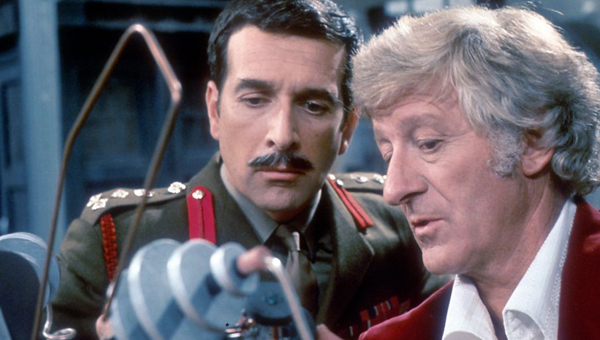
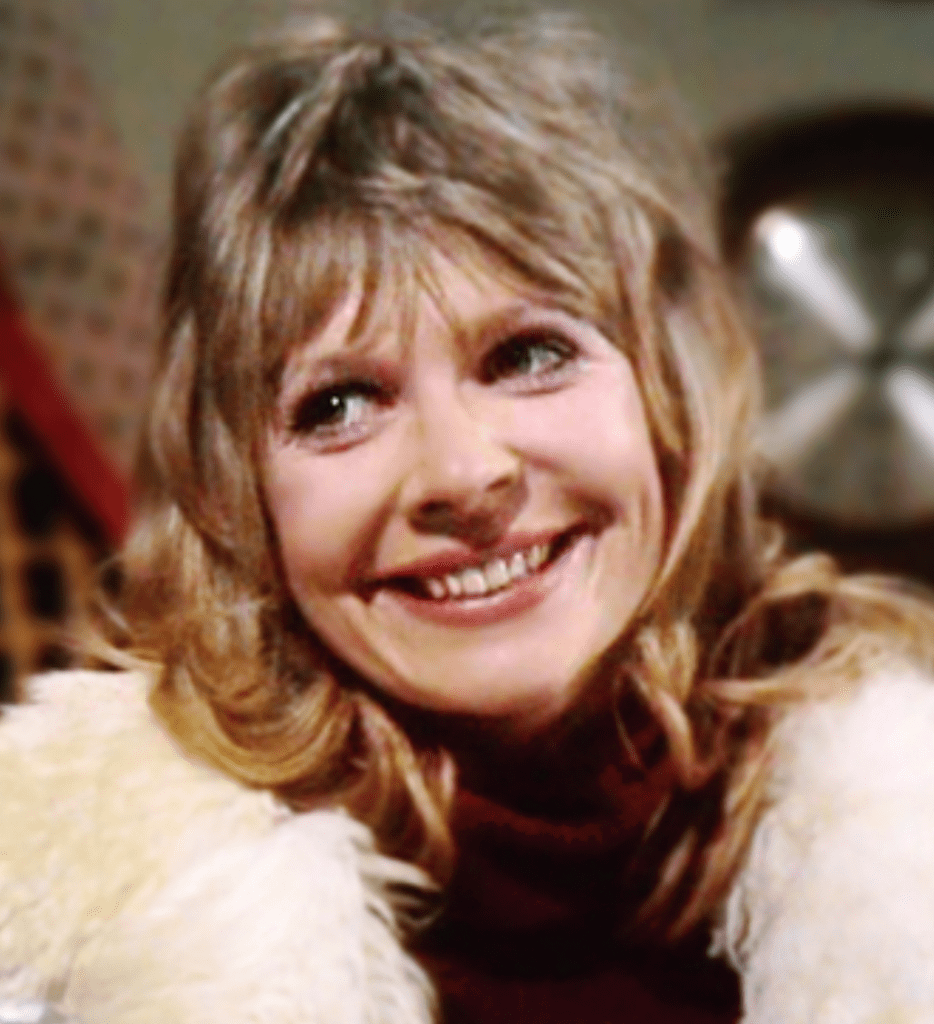
It’s right at the beginning of Pertwee’s second season – Season Eight – that all the pieces of the jigsaw fall wonderfully into place in the Robert Holmes story Terror of the Autons. It’s almost as though the production team, by now fully confident in what they wanted and the direction in which they wished to take the show, were deliberately remounting the season opener from the year before. The straightforward ‘alien invasion of Earth’ story which Pertwee’s first year had only really deployed once in the first story Spearhead from Space, also written by Holmes; the introduction of the new companion; even the return of the Autons, the same monsters which had greeted Pertwee in his first story. The crucial component, of course, is the arrival of Katy Manning’s Jo Grant, replacing Liz Shaw’s reserve, scientific detachment and slightly aloof quality with a youthful exuberance, vitality and wide-eyed innocence. Very much an early 70s ‘groovy chick’, and just a little scatty and ditzy, in lesser hands the character might easily have been no more than a grating exercise in bimbo, but Manning brings a real charm and believability to the role which grounds the whole thing and proves the perfect foil to Pertwee’s Doctor. The two actors got on very well, and their genuine affection for one another is always evident on-screen. What is also a great pleasure in watching all their stories together on iplayer, in order and very quickly, is that Jo’s ‘arc’ – giving myself brief permission to deploy that hideously overused word – becomes far more evident than it was (at least to me) at the time. Her initial naivety is coupled with courage and resourcefulness, and with an unwavering loyalty and devotion to the Doctor. As time goes on, however, she also begins to develop the confidence and independence to question and challenge him a little more, leading ultimately to the point where, in the Doctor’s own rather patronising words, ‘the fledgling leaves the nest’ and what is, for me, the most touching exit from the series any companion has ever received. The final moments of The Green Death remain extremely powerful and moving to this day, with the Doctor, alone and detached from Jo’s farewell celebrations, quietly exiting the party without a goodbye and driving Bessie off into a lonely sunset. It works so well in fact that Steven Moffat and Mark Gatiss were perfectly happy to steal it note for note for the scene of Holmes quietly exiting Watson’s wedding reception in The Sign of Three from their series Sherlock.
The arrival of Jo Grant may be the defining change of direction instituted at the beginning of Pertwee’s second season, but it’s not the only one. What came to be known by fans as the ‘UNIT family’ is completed here too, when Richard Franklyn’s Mike Yates – envisioned as a dashing action man and potential romantic interest for Jo, a narrative strand which never really went anywhere – takes his place alongside the Brig and John Levene’s Sergeant Benton. Even the uniforms change to something a bit more cosily familiar – less Special Forces and more Regular Army. And it’s also at this point that the standing set of the UNIT laboratory where the Doctor’s immobile Tardis is parked begins to be used so regularly that it genuinely starts to feel like home, for the audience if not for the Doctor. And last, but not least, is another masterstroke (see what I did there?) from the Dicks/Letts playbook, the introduction of the Master, played so wonderfully by Roger Delgado. Both producer and script editor described their thought process many times over the years – the relationship between the Third Doctor and the Brigadier reminded them of Sherlock Holmes and Dr Watson, which in turn suggested the eminently logical idea that the Doctor needed a Moriarty to test his mettle. If the Doctor’s nemesis was to be his intellectual equal, then of course he had to be another renegade Time Lord. Dicks came up with the perfect name and The Master was born.
So successful was the strategy, and so immediately effective was the chemistry between the brilliant Delgado and the rest of the regular cast – Pertwee in particular – that the Master is used as the returning villain in every single one of the Season Eight stories. It does mean that the surprise reveal tends to be a little less than surprising after a while, but the inexhaustible pleasures of watching the sparring between the Doctor, Jo and the Master more than make up for it. Letts made the decision to use him more sparingly across seasons 9 and 10, but whenever the character reappears it is a highlight. In the years since Delgado’s tragic death in a car accident in 1973 – in many ways the incident which signalled the beginning of the end for the Pertwee era – many fine actors have been cast as the Master and all of them have been wonderful but, for me at least, no-one will ever surpass the charm and menace and sheer charisma that Delgado brought to the role. After the shock of his death something of the joy drained away from the UNIT family of which he was most definitely a member, and within the year Katy Manning had gone (to be replaced by the incomparable Liz Sladen as Sarah Jane Smith), Barry Letts and Terrance Dicks were on their way out and Pertwee, after a half-hearted attempt to negotiate a more lucrative contract if he were to stay, decided that it was time for him to leave too.
Before reaching that point, however, the UNIT family era offers so many delights. The Pertwee years boast some of the most iconic individual moments in the series’ history, moments that seared themselves onto my childhood eyeballs and into my heart and memory forever. The Sea Devils emerging from the waves. The one with the maggots. Chap with wings there, five rounds rapid. The Doctor tied to the maypole and menaced by Satanic morris dancers. Miss Hawthorne and the great wizard Quiquaequod. A Sontaran removing his odd, dome-shaped silver helmet for the first time on screen to reveal – of course – his odd, dome-shaped head. That troll-doll struggling into life. Shop window dummies beginning to move. A man swallowed by a black plastic chair. A policeman turning round to reveal a faceless blank. A miniaturised Doctor and Jo chased by Drashigs inside a miniscope. Escaping from the Daleks by floating up a vent on the hot air.
It’s not only isolated moments, however. There are whole stories that continue to be among my favourites from any era of the show. The Daemons harnesses the folk horror zeitgeist and national fixation with the rural occult of the early 70 by rather wonderfully mashing together Dennis Wheatley, Quatermass and the Pit and Hammer’s The Witches to come up with something entirely Doctor Who, and remains one of my favourite bits of Halloween viewing to this day, even if strictly speaking I should be watching it at Beltane instead. The Three Doctors, celebrating the show’s tenth anniversary with the first ever multi-doctor story – just about the most exciting thing to have ever happened in the history of exciting things as far as my eight-year-old self was concerned – institutes this fantastic idea as a tradition, and also institutes the less welcome tradition of production difficulties associated with the device. In this instance, William Hartnell’s poor health necessitated some drastic rewriting in order to confine his appearances to the Tardis monitor, just as later Tom Baker would refuse to appear in The Five Doctors (a problem solved with a smart use of some previously unseen footage from the abandoned production Shada) and Christopher Eccleston threw a spanner in the works of Steven Moffat’s fifty year anniversary special The Day of the Doctor, requiring the invention of a ‘missing’ Doctor in the magnificent form of John Hurt. Even better than the simple idea of bringing past Doctors together, however, was the wonderful and quite unexpected idea The Three Doctors gave us that the Doctors wouldn’t get on with one another, spending much of the time bickering and point-scoring in a way that continues to entertain and remains one of the central appeals of the multi-Doctor story to this day. The Day of the Daleks is possibly the first ‘timey-wimey’ Doctor Who story, a paradox tale I found mind-bogglingly marvellous at the time – and still do if I’m honest, even if I now know Pertwee hated it – inventing a mode for the programme which Moffat would later take to operatic new heights. The Curse of Peladon, perhaps Doctor Who’s first galaxy-building mish-mash of alien civilisations (including the return of the Ice Warriors, who didn’t scare me any more now they were in colour) a few years before the Mos Eisley cantina of Star Wars and much longer before Russell T Davies adopted the approach in The End of the World and returned to it in the subsequent Year 5 Billion stories.
And although it may not be quite so highly thought of by most fans, Pertwee’s final story Planet of the Spiders is right up there with the best of them. What is most interesting is the tone the story establishes, which is both celebratory and elegiac. It feels, on the one hand, like a wonderful Greatest Hits package now that the band was breaking up. Throughout the six episodes, there’s a strong sense of past glories. There’s a nod to the past from the outset, with a letter from Jo Grant (now on her Amazonian adventure with Professor Jones) being read aloud and the blue crystal from Metebelis 3, which the Doctor gave her as a wedding present, serving as Hitchcock’s MacGuffin for this story. The return of Mike Yates from exile, attempting to redeem himself after his misguided betrayal of UNIT and the Doctor in Invasion of the Dinosaurs. More than half of episode two is devoted to one long chase sequence which involves Bessie, the Whomobile (both on the road and in the air), a gyrocopter , a speedboat and a hovercraft, indulging Pertwee’s love of speed and gadgets one last time. There’s the tendency of the show under Barry Letts to focus on current issues and trends – in this instance the idea of the rural meditation retreat which became so faddish in the 70s – and using the setting to beautifully payoff one of the era’s most celebrated moments from the earlier The Time Monster, by revealing that the Hermit the Doctor described to Jo who had taught him the true joy of existence through “the daisiest daisy I’d ever seen… It was simply glowing with life, like a perfectly cut jewel. And the colours? Well, the colours were deeper and richer than you could possibly imagine” is in fact K’anpo Rimpoche, the Abbot of the Tibetan meditation retreat. There are the isolated, incredibly memorable standalone images and incidents that helped define the era, most notably the giant spider on Sarah Jane’s back, controlling her, which is certainly the forerunner of the central image of a beetle, mostly invisible, on Donna’s back in Turn Left, one of the most memorable episodes of David Tennant’s time as the Doctor.

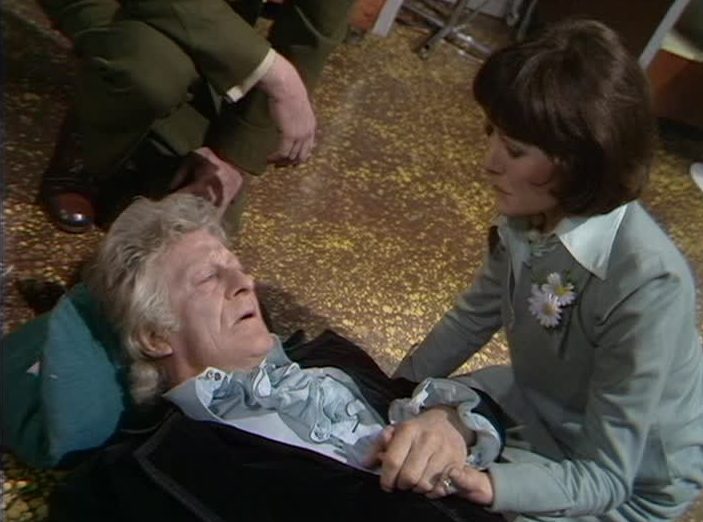
But there’s also the sense of an ending. Planet of the Spiders is the first time that a regeneration story seems to become a story about regeneration, and the first time that regeneration is seen as something akin to dying. When Hartnell becomes Troughton at the end of The Tenth Planet it’s simply an unexpected moment at the end of an unconnected story. When the final episode of Troughton’s epic ten-part The War Games sees the Doctor put on trial by the Time Lords for interference in the affairs of other civilisations, the idea that part of his punishment – alongside the exile to Earth which was the central setup for the Pertwee years – is to change his appearance (the word ‘regenerate’ is not used until the end of Planet of the Spiders itself) is almost an afterthought. In Planet of the Spiders, however, something in this final story strikes a sombre note of foreboding from the beginning, which lends a kind of tragic inevitability to the Doctor’s ultimate fate, just as it would do in Logopolis at the end of Tom Baker’s tenure seven years later. It’s there, somehow, oddly and obscurely, in the moments where the character of Tommy, child-like and simple minded, is influenced by the power of the crystal and, in Flowers for Algernon style, is soon devouring Blake and speaking in Standard English tones rather than Deepest Mummerset to indicate the flowering of his intelligence. It’s there in the powerful sense of wrongness that permeates the secret basement ceremonies, the chanting manifesting a giant spider in the centre of the meditation circle like an embodiment of the men’s perversion of the ritual, their lust for power in this world rather than the search for enlightenment. It’s there, most of all, in Pertwee’s meeting with his old mentor, who points out to him that, in essence, this is all his fault and he must now face the consequences of his irresistible need to know, which, in its own way has consumed him as much as the will to power has consumed Lupton. Not all spiders, he is told, are on the back. His initial reluctance – “Is there no other way?” – is a subtler, and perhaps in the end more effective, dress rehearsal for David Tennant’s grandstanding attempts to avoid his fate in the last few episodes of the Tenth Doctor era. And the final moments in which he stumbles out of the Tardis and collapses onto the floor of the UNIT lab which, touchingly, he refers to here as ‘home’, with a tearful Sarah kneeling over him while the Brigadier maintains the stiff upper lip, are the first in the series history which show the process as a kind of death. Pertwee acts so beautifully here – as he does throughout his time on the show come to that – that sadness becomes the sorrowful, bittersweet note on which each succeeding regeneration is built, all of them remarkably effective in pulling on the heartstrings (except you, Sixth Doctor into Seventh…Sylvester lying face down in a Colin Baker wig? Because he bumped his head! Michael Grade, I’ll never forgive you) and all of them owing most not so much to The Tenth Planet or The War Games as to this, the final moment of the Pertwee years.
And so it was over, after five years of real time or a couple of weeks in The Whoniverse depending on how you look at it. The Pertwee years had been an unqualified success, averting the threat of cancellation which had been a real possibility at the end of Troughton’s tenure, moving the show out of 60s black and white into a full colour world and establishing it as a genuinely iconic and central part of British culture with viewing figures that secured the future of the programme. It was the Pertwee years that cemented the show’s place in television history and which made a lifelong fan of me.
I will be eternally grateful to all those responsible for bringing those stories and those moments to the screen. They meant so much to me, then and in the years since. I continue to believe that it was being lucky enough to be exposed as a child to stories that sparkled and soared in my imagination, expanding my mind and my horizons – with Pertwee’s Doctor Who right at the centre of it – which fuelled and nurtured whatever capacity for creativity I may have today. With all my heart (or hearts), thank you. Thank you to the crew and the directors and the writers. Thank you Terrance and Barry. Thank you Caroline and Katy and Liz. Thank you Nicholas and Richard and John. Thank you Roger. And most of all, thank you Jon. My Doctor.
Now, if you’ll excuse me. It’s time for Tom. Who is also my Doctor.
 Dracula, Frankenstein and Friends